


.png)
Partnership marketing gives businesses a way to grow faster by combining strengths with complementary brands. From affiliate and loyalty partnerships to barter exchanges and distribution agreements, each model offers a different route to expanding your reach, adding customer value and building campaigns you couldn't deliver alone.
This blog breaks down ten types of marketing partnerships and helps you choose the right one for your brand.
Contents:

Key Takeaways
-
Loyalty partnerships extend the value of your rewards programme by giving customers access to benefits across complementary brands.
-
Barter exchange lets businesses acquire goods or services without cash by trading excess inventory or spare capacity.
-
Affiliate marketing delivers cost-effective, measurable acquisition by paying partners only for the results they generate.
-
Distribution partnerships create access to established networks and logistics, getting your product to market faster.
-
White label partnerships offer the quickest route to launching new products without investing in development from scratch.
-
Referral partnerships drive high-quality leads at low cost through trusted, word-of-mouth recommendations.
-
Sponsorship partnerships build emotional brand association by connecting you with events and causes your audience cares about.
-
Strategic B2B partnerships combine complementary strengths to unlock markets and capabilities neither business could reach alone.
-
Social responsibility and charity partnerships strengthen brand reputation while creating genuine, visible community impact.
-
Product placement puts your brand in front of audiences during moments of high engagement within popular media content.
What Should You Consider When Choosing a Marketing Partner?
Choosing well comes down to evaluating a few key factors before you commit.
-
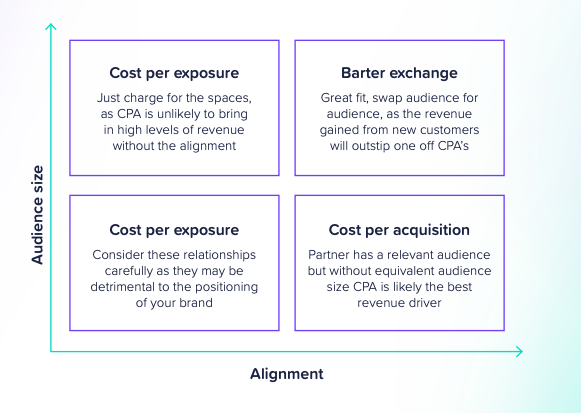
Complementary Offerings: Choose partners whose offerings complement yours, creating genuine cross-promotion opportunities and added value for both audiences.
-
Shared Values and Brand Alignment: Make sure your partner's values and brand image align with yours. Inconsistency here erodes customer trust quickly.
-
Reach and Influence: Evaluate partners' reach and influence to assess potential for increased brand exposure.
-
Resources and Capabilities: Assess the resources, expertise, capabilities, and service offerings of potential partners to identify how they can contribute value to your business and customers.
-
Target Audience Alignment: Look for partners whose target audience closely aligns with yours to ensure your marketing efforts reach the right people with genuine interest in your products or services.
-
Trust and Credibility: Partner with reputable brands that strengthen your brand's perception rather than undermining it.
-
Mutually Beneficial Goals: Establish clear, aligned objectives from the outset so both parties are working towards a genuine win-win.
-
Collaboration and Communication: Prioritise partners who commit to open, transparent communication and effective collaboration throughout the relationship.
-
Legal and Contractual Considerations: Address legal aspects like agreements, intellectual property, exclusivity, and confidentiality to protect all parties.
-
Measurement and Evaluation: Define KPIs upfront and agree on how you'll measure the partnership's impact against your business objectives.
When selecting marketing and brand partners as part of your overall partner marketing strategy, these factors will help ensure the partnership succeeds and benefits both sides.
Maximise collaboration benefits by choosing the partnership model that best aligns with your goals, target audience, and brand values.
Comparison Table: How Do Different Types of Marketing Partnerships Compare?
It's worth noting that certain fundamentals apply across all of them.
-
Every partnership works best when both parties share aligned values, clearly defined goals and complementary target audiences.
-
Legal and contractual considerations (covering IP, confidentiality and exclusivity) should be addressed early.
-
Open communication, agreed KPIs and regular performance reviews keep things on track.
-
And every partnership needs enough flexibility to evolve as circumstances change.
With those universals in place, here's what distinguishes the types of partner programmes:
|
Partnership Type
|
|
|
|
|
|
|
|
|
|
|
|
|
|
|
|
|
|
|
|
|
|
|
|
|
|
|
|
|
|
|
|
|
|
|
|
|
|
|
|
|
|
|
|
|
|
|
|
|
|
|
|
|
|
What Are the Most Common Types of Marketing Partnerships?
There are ten partnership models that businesses use most frequently, each suited to different goals, resources and audiences.
-
Loyalty Partnerships
-
Barter Exchange
-
Affiliate Marketing
-
Distribution Partnerships
-
White Label Partnerships
-
Referral Partnerships
-
Sponsorships
-
Strategic B2B Partnerships
-
Social Responsibility & Charity Partnerships
-
Product Placement
Here's a detailed breakdown of how these partnership models work and where they fit within a broader partner marketing strategy.
1. What Is a Loyalty Partnership?
A loyalty partnership is a collaboration between two or more businesses that combine their loyalty programmes or rewards to offer customers shared benefits. Rather than each brand operating its programme in isolation, the partnership creates a joint experience where customers earn and redeem rewards across both brands.
Which Industries Benefit Most from Loyalty Partnerships?
-
Health & Fitness: Gyms, wellness centres, and health-related businesses can partner with nutrition brands, fitness equipment manufacturers, or sports retailers to offer joint loyalty programmes.
-
Retail and Ecommerce: Retailers, both brick-and-mortar stores and online platforms, can form loyalty partnerships to expand their customer base and provide additional incentives.
-
Financial Services & Insurance: Banks, credit card issuers, and financial institutions can collaborate with merchants to offer loyalty programmes tied to financial transactions.
-
Travel and Hospitality: Airlines, hotels, car rental companies, and travel agencies can form partnerships to offer customers the ability to earn and redeem rewards across different travel-related services.
-
Entertainment & Media: Entertainment venues can partner with other businesses in the industry, such as streaming services or gaming platforms, to provide comprehensive loyalty programmes.
What Are the Advantages of Loyalty Partnerships?
-
Increased loyalty and retention through emotional connections: Loyalty partnerships foster emotional connections with customers, deepening loyalty and increasing repeat business and long-term retention.
-
Competitive advantage: Offering an extensive and attractive loyalty program differentiates businesses from competitors and incentivises customers to choose their products or services.
-
Increased customer engagement: Loyalty partnerships encourage customers to engage with multiple brands, boosting overall participation and interactions.
-
Increased brand visibility: Leveraging each other's customer bases and marketing channels expands brand visibility to new audiences.
-
Enhanced customer experience: Loyalty partnerships provide a seamless and integrated experience across different brands, making it easier for customers to access and enjoy loyalty programme benefits.
What Are the Drawbacks?
-
Brand dilution: If not executed properly, loyalty partnerships may dilute a brand's identity, confusing customers and weakening brand perception.
-
Complex implementation: Coordinating different loyalty systems, tracking rewards, and ensuring a seamless customer experience can be complex and require ongoing maintenance.
-
Misalignment of customer preferences: Meeting all customer expectations in a partnership can be challenging, potentially leading to dissatisfaction or disengagement.
-
Potential competitive disadvantage: Loyalty partnerships carry the risk of giving competitors access to a customer base, potentially leading to customers switching their loyalty to the partner brand.
What Does a Loyalty Partnership Look Like in Practice?

Image: starbucksbenefits.com
The collaboration between Starbucks and Spotify highlights the possibilities of merging digital loyalty programmes from beverage brands with music streaming services. As younger demographics increasingly use smartphones for content, the integration of cross-partnership rewards can attract them to join loyalty programmes that offer combined benefits.
2. What Is a Barter Exchange Partnership?
Barter exchange is a trade system where goods or services are directly swapped between two parties without using money. It involves exchanging one item or service for another based on mutual agreement. Barter can occur informally or through organised networks or platforms that facilitate and coordinate these transactions.
Which Industries Benefit Most from Barter Exchanges?
Almost any industry can benefit from barter exchange, offering flexibility, cost savings, and access to resources or services not easily available through traditional monetary transactions.
-
Hospitality and Travel: Hotels, resorts, and travel agencies can utilise barter exchange to fill vacant rooms or seats during off-peak periods by trading them for goods or services they need, such as advertising, maintenance, or supplies
-
Retail: Businesses manage excess inventory and obtain products or services without cash by trading their goods.
-
Media and Advertising: Media companies and agencies trade advertising space for products, services, or media buying credits.
-
Healthcare and Wellness: Providers exchange services for healthcare, equipment, or wellness products.
-
Food and Beverage: Suppliers trade food supplies, ingredients, or catering services, reducing waste and managing costs.
What Are the Advantages of Barter Exchange?
-
Cost savings: Barter allows businesses to acquire goods or services without spending money, helping them save on cash expenses.
-
Utilisation of excess inventory or capacity: Barter exchange enables businesses to trade their excess inventory or unused capacity for items they need, maximising the utilisation of resources.
-
Access to needed goods or services: Barter provides an alternative means to obtain goods or services that may not be easily accessible or affordable through traditional monetary transactions.
-
Relationship building: Barter exchange fosters relationships and collaborations between businesses, potentially leading to long-term partnerships and mutual support.
-
Flexibility and creativity: Barter transactions offer flexibility in negotiating the terms of exchange and allow for creative solutions to meet business needs.
What Are the Main Drawbacks?
-
Lack of direct value equivalence: Establishing a fair exchange can be challenging when goods or services have different values.
-
Limited options and availability: Finding compatible partners may restrict the range of options.
-
Complex negotiation and coordination: Barter requires careful negotiation and coordination, which can be time-consuming.
-
Difficulty in measuring value and tracking transactions: Valuation and tracking can be challenging without clear methods.
-
Reliance on trust and reputation: Trust is essential, as there is no direct monetary exchange.
What Does a Barter Exchange Look Like in Practice?
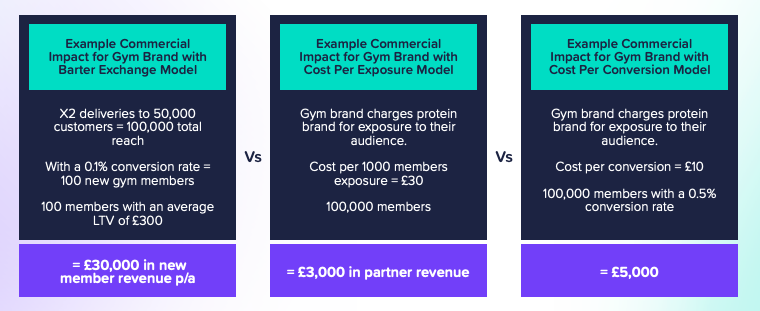
A leading national gym chain approaches a protein brand to engage in a partner marketing barter exchange model. The gym brand has 100,000 members, and the protein brand has 50,000 customers. Via a barter exchange relationship, the gym brand offers space on their online rewards programme in return for x2 inserts in the protein brand’s ecommerce sales deliveries.
Back to Contents
3. What Are Affiliate Marketing Partnerships?
An affiliate marketing partnership is an arrangement where one business (the affiliate) promotes another business's products or services through their own marketing channels. The affiliate drives traffic to the provider's website or platform and earns a commission for each successful referral or sale.
Unlike many other marketing models, affiliate performance can be precisely tracked and measured through digital programme metrics and partnership KPIs, making it one of the most accountable forms of partner marketing.
Insight from Lee Metters, Brand Partnerships Client Partner
Awin – Global Affiliate Marketing Platform:
"Brand-to-brand (B2B) partnerships enable online retailers to create innovative acquisition campaigns with complementary brands and leverage tailored rewards to help accelerate the customer loyalty life cycle.
Partnering brands can offer value-added rewards to existing and new audiences, either at the point of purchase or as a retrospective targeted follow-up.
Measuring ad-spend and return on investment can be difficult with a traditional partnership marketing campaign as brands are reliant on partner brands passing back performance data. This is time-consuming and brands are less flexible to react and optimise campaigns in real-time."
Which Industries Benefit Most From Affiliate Marketing?
-
Ecommerce and Retail: Online retailers partner with content creators, bloggers, and influencers to promote products and earn commissions on sales.
-
Travel and Hospitality: Travel agencies and platforms collaborate with travel bloggers and influencers to promote destinations and accommodations, earning commissions on bookings.
-
Fashion and Beauty: Fashion brands work with influencers to showcase products, sharing referral links for commissions on purchases.
-
Financial Services: Banks and investment platforms partner with finance-related websites and bloggers, earning commissions for customer referrals or leads.
-
Software and Technology: Companies collaborate with influencers and bloggers to review and recommend products, earning commissions on purchases or subscriptions.
-
Health and Fitness: Health brands partner with fitness influencers and bloggers, earning commissions on sales or receiving sponsorships for product features.
-
Entertainment and Gaming: Companies in these industries collaborate with YouTubers and streamers to promote games and merchandise, earning commissions on purchases.
Affiliate marketing can be found in almost any industry, providing a cost-effective way to drive targeted traffic and increase conversions.
What Are the Advantages of Affiliate Marketing Partnerships?
-
Cost-effective: Pay for actual results achieved.
-
Expanded reach: Tap into affiliate audiences for new customer exposure.
-
Targeted audience: Reach the ideal customer base through niche affiliates.
-
Increased brand credibility: Trusted affiliates enhance brand reputation.
-
Performance-based model: Pay for measurable results, driving higher conversions.
-
Diversification of marketing channels: Supplement other marketing efforts.
-
Scalability: Easily expand by adding more affiliates.
-
Data-driven insights: Gain valuable data for optimisation.
-
Long-term value: Continuity and ongoing promotions by affiliates can lead to sustained sales and customer acquisition over time.
What Are the Drawbacks?
-
Revenue uncertainty tied to affiliate partner performance and market fluctuations.
-
Affiliate partner dependent whose actions and decisions can impact revenue.
-
Limited control over the sales process, relying on affiliate partners' websites and processes.
-
Varied commission structures and potential payout delays.
-
Brand association and reputation risks if affiliate partners offer subpar products or services.
-
High competition in the affiliate marketing field, making it challenging to stand out.
-
Compliance with regulations and potential legal issues related to advertising and data protection.
Proper planning, careful partner selection and a clear set of programme terms go a long way towards mitigating these risks. Working with an established platform like Awin can also help by providing the infrastructure, tracking and oversight to manage affiliate relationships at scale.
Back to Contents
4. What Is a Distribution Partnership?
Distribution partnerships are collaborative agreements where a manufacturer or supplier partners with a distributor to sell their products or services. The distributor handles marketing, sales, and logistics, leveraging their networks to reach more customers and expand market reach. These partnerships help businesses enter new markets, target specific segments, and increase sales.
What Are the Subtypes of Distribution Partnerships?
Distribution partnerships typically fall into two strategic models:
-
Cross marketing
Cross marketing in distribution partnerships involves businesses collaborating to promote each other's products or services to their customers. This includes joint advertising campaigns and co-branded marketing materials for increased exposure and reaching new customer segments.
-
Bundling
Bundling in distribution partnerships involves combining complementary products or services into a single offering, providing added value to customers and increasing sales opportunities. It allows businesses to leverage each other's customer base and distribution channels, expanding market reach and cross-selling potential. Bundling creates convenience, cost savings, and enhanced functionality for customers while driving customer satisfaction and loyalty.
Which Industries Benefit Most from Distribution Partnerships?
Distribution partnerships are most common in industries where reaching customers at scale requires established logistics, retail relationships or platform access.
-
Consumer Goods: Food, beverage, household products, personal care, and electronics industries rely on distribution partnerships for retail and online reach.
-
Retail: Retailers partner with suppliers to expand their offerings and ensure a steady supply of products.
-
Technology: Technology companies join forces with distributors and resellers to expand their customer base and sell software and hardware products.
-
Fashion and Apparel: Fashion brands partner with retailers, department stores, and e-commerce platforms to gain visibility and expand their reach.
-
Publishing and Media: Publishers, book distributors, and media companies collaborate to distribute books, magazines, newspapers, and digital content.
-
Food and Beverage: Food and beverage manufacturers collaborate with distributors and wholesalers to reach grocery stores, restaurants, and foodservice establishments.
-
Hospitality and Tourism: Hotels, resorts, and travel agencies form partnerships with online travel agencies and booking platforms to increase visibility and attract customers.
What Are the Advantages of Distribution Partnerships?
-
Expanded Market Reach: Access new markets and reach a wider customer base by partnering with a distribution company.
-
Increased Sales and Revenue: Collaboration with a distribution partner generates additional sales opportunities, resulting in higher revenue for both parties.
-
Cost Efficiency: Save costs by leveraging the partner's existing logistics, warehousing, and delivery systems.
-
Market Expertise: Gain valuable market knowledge and insights from the distribution partner to make informed decisions and stay ahead of the competition.
-
Speed to Market: Enter new markets or launch products faster by leveraging the partner's established infrastructure.
-
Brand Exposure and Credibility: Enhance brand exposure and credibility by associating with a reputable distribution company.
-
Mutual Growth Opportunities: Collaborate with the partner to drive innovation, expand product offerings, and explore new market segments for long-term success and growth.
What Are the Drawbacks?
-
Loss of Control: Businesses may have limited control over the distribution process and how their products/services are presented.
-
Dependency on Partner: The success of the distribution strategy relies on the partner's performance and capabilities.
-
Profit Sharing: Distribution partnerships involve sharing profits, reducing overall profitability.
-
Limited Flexibility: Partnerships may restrict flexibility in pricing, promotions, and distribution strategies.
-
Potential Conflicts of Interest: Collaborating closely with a partner can lead to conflicts in priorities or strategies.
-
Loss of Direct Customer Relationships: Limited access to customers may hinder building direct relationships and gathering insights.
-
Dependency on Partner's Reputation: Partner's reputation can impact the perception of the business's offerings.
-
Contractual Obligations: Partnerships entail contractual limitations and requirements.
Back to Contents
5. What Is a White Label Partnership?
A white label partnership is an arrangement where one company produces a product or service and another company sells it under their own brand. The white label provider handles production, while the partner focuses on marketing and sales. It's a way to expand your product range without investing in the development or infrastructure needed to build from scratch.
Which Industries Benefit Most From White Label Partnerships?
-
Technology: Companies offering software solutions, mobile applications, or IT services often provide white label options to other businesses, allowing them to rebrand and resell the technology as theirs.
-
E-commerce: Online retailers and marketplaces may partner with white label providers to offer a range of products under their own brand, without the need for manufacturing or inventory management.
-
Financial Services: Banks, fintech companies, and payment processors may use white-label partnerships to offer customised financial products and services, such as payment gateways, mobile banking apps, or credit cards.
-
Health and Wellness: Companies in the health and wellness industry, including supplements, vitamins, and fitness equipment, may partner with white label manufacturers to create customised products under their brand.
What Are the Advantages of a White Label Partnership?
-
Faster time to market: White label partnerships enable quick product/service launches, outpacing competitors.
-
Cost savings: Businesses save on R&D, production facilities, and specialised equipment expenses.
-
Brand expansion and customisation: White label solutions can be customised and rebranded to align with a company's brand identity and target market.
-
Access to expertise: Partnering with white label providers grants access to industry knowledge, established processes, and quality standards.
-
Scalability and flexibility: White label partnerships offer the flexibility to meet fluctuating demand and scale production without major investments.
-
Competitive advantage: Diversifying product/service offerings through white label partnerships strengthens market position and attracts and retains customers.
-
Focus on core competencies: Outsourcing to white label providers allows businesses to concentrate on their strengths, such as innovation and marketing.
-
Risk Mitigation: White label solutions mitigate risks associated with product failures, market acceptance, and production challenges.
What Are the Main Drawbacks?
-
Limitations on Differentiation: White label partnerships restrict the ability to differentiate products or services, limiting competitive advantage.
-
Dependency on White Label Provider: Businesses become reliant on the performance of the white label provider, risking reputation and customer satisfaction if issues arise.
-
Loss of Control: Partnering with a white label provider means surrendering control over production and immediate changes or improvements.
-
Brand Dilution: Use of white label products or services can dilute a company's brand identity, potentially diminishing recognition.
-
Profit Margins: Sharing revenue with the white label provider may result in lower profit margins compared to proprietary offerings.
-
Risk of Competition: Multiple companies utilising the same white label solution may lead to direct competition and reduced differentiation.
Back to Contents
6. What Is a Referral Partnership?
In a referral partnership, each party agrees to refer potential customers or clients to the other party, typically in exchange for mutual benefits such as financial compensation, commissions, reciprocal referrals, or other rewards.
Which Industries Benefit Most from Referral Partnerships?
A referral partnership works best in industries where trust and personal recommendation carry significant weight in the buying decision.
-
Financial Services: Banks, insurance companies, and investment firms leverage referral partnerships to gain new clients, especially through collaborations with other businesses or professionals in related fields
-
Software and Technology: Software companies, SaaS providers, and technology platforms frequently use referral partnerships to expand their user base, with existing customers referring others to their products or services.
-
Hospitality and Travel: Hotels, resorts, travel agencies, and vacation rental platforms establish referral partnerships to generate bookings, encouraging current customers to refer others and earn rewards or discounts.
-
Fitness and Wellness: Gyms, fitness studios, and wellness centres often have referral programmes to encourage members to bring in new customers, driving membership growth.
What Are the Advantages of a Referral Partnership?
-
Increased reach and exposure to a new audience.
-
Cost-effective marketing through word-of-mouth referrals.
-
Trust and credibility gained from recommendations by trusted sources.
-
Higher-quality leads from individuals who have already shown interest or trust in the referring business.
- Mutual benefit for both parties involved, leading to increased revenue and customer base expansion.
-
Strengthened relationships and potential for long-term partnerships.
-
Enhanced customer loyalty and satisfaction through trusted recommendations.
-
Diversification of lead sources, reducing dependency on a single marketing channel.
-
Opportunity for sustainable business growth and a more stable customer acquisition strategy.
What Are the Drawbacks?
The main risks revolve around dependency, control, and consistency, all of which can be managed with the right structure but shouldn't be overlooked.
-
Reliance on referring partners, which can impact referrals if their business performance declines or the partnership ends. To mitigate this risk, it's important to establish a diverse network of referring partners and regularly evaluate their performance.
-
Limited control over messaging and recommendations by referral partners. While it's essential to give partners the freedom to promote their business in a way that aligns with their brand, it's crucial to ensure that their messaging and recommendations are in line with your brand's values and guidelines.
-
Potential for an unequal exchange of referrals, which necessitates clear expectations and guidelines for fairness. The terms of the partnership should be clearly established to ensure that both parties benefit equally from the partnership.
-
Misalignment between target audience and partner offerings can also reduce the relevance and value of referrals. It's important to choose partners whose offerings align with your target audience to ensure that the referrals are valuable and relevant.
-
Management and tracking challenges in accurately crediting and rewarding referrals can be a significant hurdle in referral partnerships. The process of tracking referrals and providing rewards should be well-organised to avoid any misunderstandings or disputes.
Back to Contents
7. What Is a Sponsorship Partnership?
A sponsorship partnership is an arrangement where the sponsor provides financial or material support to an event, organisation or individual in exchange for promotional benefits. The sponsor gains exposure and access to the sponsored party's audience, while the sponsored party receives the resources they need to operate, grow or stage their event.
Which Industries Benefit Most from Sponsorship Partnerships?
Sponsorships are most effective in industries where live audiences, cultural relevance and emotional engagement create natural opportunities for brand association.
-
Sports: Sports sponsorships are prevalent, with companies supporting professional sports teams, leagues, athletes, and sporting events.
-
Technology: Tech companies often engage in sponsorships to showcase their products or services at technology conferences, trade shows, or innovation events.
-
Automotive: Automotive companies frequently sponsor motorsports events, car shows, and other automotive-related activities.
-
Fashion and Beauty: Sponsorships are commonly seen in the fashion and beauty industry, supporting fashion shows, beauty pageants, and brand collaborations.
-
Financial Services: Banks, insurance companies, and financial institutions often engage in sponsorships related to sports, charity events, and financial education programmes.
-
Health and Wellness: Sponsorships in the health and wellness industry involve fitness events, marathons, wellness expos, and health-related campaigns.
What Are the Advantages of Sponsorship Partnerships?
-
Brand Exposure: Sponsors gain targeted brand exposure and recognition through promotional opportunities provided by the sponsored parties.
-
Targeted Marketing: Sponsorships enable targeted marketing to reach desired audiences effectively.
-
Positive Brand Association: Sponsors benefit from positive brand association by aligning with reputable sponsored parties whose values, reputation, and audience perception reflect positively on the sponsor's brand image.
-
Consumer Engagement: Sponsorships offer direct consumer engagement, product showcasing, and valuable insights.
-
Differentiation and Competitive Advantage: Sponsorships differentiate sponsors from competitors and attract consumer attention through association with unique events or organisations.
-
Emotional Connection: Sponsorships create emotional connections with consumers by supporting causes or events that resonate with their values, fostering brand loyalty.
-
Networking and Partnerships: Sponsorships enable networking and partnerships with industry leaders and stakeholders, leading to collaborations that benefit all parties involved.
-
PR and Media Coverage: Sponsorships generate media coverage, increasing reach, visibility, and positive PR.
-
Community and Corporate Social Responsibility (CSR): Sponsoring local events or community initiatives enhances a brand's reputation and fosters goodwill.
-
Return on Investment (ROI): Sponsorships yield ROI by increasing brand exposure, engagement, and image, resulting in increased sales, customer acquisition, and loyalty.
What Are the Drawbacks?
-
Financial commitments: Sponsorship partnerships require financial commitments that can be challenging for smaller businesses or organisations with limited budgets.
-
Dependency on sponsor: Dependency on sponsors can impact partnership stability if their circumstances change, such as a merger or financial difficulties.
-
Conflicting objectives: Sponsors' goals may not always align with those of your organisation, requiring compromise or negotiation that can affect your desired partnership outcomes.
-
Competitive exclusivity: Sponsorship agreements may limit your options and revenue streams by granting exclusivity to sponsors within their industry or category.
-
Brand association: Carefully assess a sponsor's reputation and conduct due diligence to avoid potential damage to your brand image.
-
Limited control over messaging: Sponsors may limit creative freedom and messaging flexibility, impacting authenticity of communication.
-
Relationship management: Successful sponsorships require ongoing communication, collaboration, and coordination between parties. Strained or misaligned relationships can impact the partnership's effectiveness.
Back to Contents
8. What Is a Strategic B2B Partnership?
Strategic business-to-business partnerships are collaborative relationships between two businesses that leverage each other's strengths, resources and expertise to achieve shared goals. These partnerships go beyond simple supplier-buyer arrangements. They involve deeper collaboration, such as joint ventures, content partnerships, co-development projects or shared market access, with both parties investing in the outcome.
Which Industries Benefit Most from Strategic B2B Partnerships?
Strategic B2B partnerships deliver the most value in industries where growth, innovation, or market access depends on combining capabilities that no single business can easily build alone.
-
Technology: Tech companies partner to enhance products, access new markets, and leverage technological capabilities, such as software companies collaborating with hardware manufacturers on R&D.
-
Manufacturing and Supply Chain: Manufacturers partner with suppliers, distributors, or logistics providers to improve their supply chain efficiency through shared resources, joint production, or specialised services.
-
Healthcare and Pharmaceuticals: Healthcare sees strategic partnerships between pharmaceutical companies, hospitals, medical device manufacturers, and research institutions focusing on drug development, clinical trials, innovation, and patient care.
-
Financial Services: Financial firms partner to expand products, enhance customer experiences, or enter new markets with payment processors, technology providers, or fintech startups.
-
Retail and Consumer Goods: Retailers partner with suppliers, distributors, and e-commerce platforms to enhance supply chain efficiency and customer experiences through strategic collaborations.
-
Energy and Utilities: Energy companies partner to develop renewable projects, explore new technologies, or optimise energy networks. This involves energy producers, grid operators, manufacturers, and research institutions.
-
Professional Services: Professional service providers engage in strategic partnerships to expand services, access new markets, and combine expertise for comprehensive client solutions.
What Are the Advantages of Strategic B2B Partnerships?
-
Access to new markets and customers: Partnerships can accelerate business growth by accessing new markets and customers that may be difficult to reach individually.
-
Resource sharing and cost efficiency: Strategic partnerships allow businesses to share resources, expertise, and costs, resulting in cost savings, improved efficiency, and access to specialised skills and technologies.
-
Expanded product or service offerings: Partnering with complementary businesses expands product/service offerings, meeting customer needs and increasing competitiveness.
-
Enhanced competitive advantage: Strategic partnerships offer a competitive edge through shared strengths, resources, and capabilities.
-
Increased brand visibility and credibility: Partnering with a trusted company enhances brand credibility and perception among customers and stakeholders.
-
Collaborative innovation and knowledge sharing: Strategic partnerships enable collaborative innovation and accelerated learning.
-
Risk mitigation and shared responsibility: Partnerships provide a support system and joint problem-solving to mitigate risks and navigate uncertain market conditions.
-
Strengthened customer relationships: Partnering can lead to stronger customer relationships, increased loyalty, and satisfaction through personalised solutions.
-
Market differentiation: Strategic partnerships offer a competitive edge through unique joint offerings and can attract new customers.
-
Long-term growth and sustainability: Strategic partnerships provide a platform for ongoing collaboration, adaptation, and mutual support, contributing to long-term growth and sustainability.
What Are the Main Drawbacks?
Deeper partnerships require more management and carry higher stakes if things go wrong.
-
Loss of control: Partnering means sharing decision-making, resulting in a loss of control over some aspects of the partnership and operations.
-
Cultural differences and conflicts: Cultural differences can cause conflicts in partnerships, requiring compromise or adjustment in communication, decision-making, or operational approaches.
-
Dependence on partner: Dependency on partners for resources, expertise, or market access can disrupt operations and impact business success if they fail to deliver or experience setbacks.
-
Competitor access: Sharing with a partner in strategic partnerships could give competitors access to sensitive data or insights, posing risks to competitive advantage.
-
Relationship strain: Successful partnerships require ongoing effort and collaboration to avoid communication breakdown, trust erosion, and diverging priorities.
-
Limited flexibility: Partnerships limit a business's flexibility and restrict certain actions or freedom due to commitments and obligations.
-
Brand association risks: Partnering requires careful due diligence to mitigate potential risks to the brand's image and reputation.
-
Time and resource investment: Maintaining a strategic partnership demands time, effort, and ongoing communication that can be challenging for businesses with limited capacity.
-
Misaligned objectives: Partners may have differing objectives, requiring negotiation and impacting outcomes.
-
Partnership dissolution complexities: Dissolving a failing partnership can have complex legal and financial consequences.
Back to Contents
9. What Is a Social Responsibility and Charity Partnership?
Social responsibility and charity partnerships refer to collaborative relationships between businesses and nonprofit organisations or charitable causes. Businesses form these partnerships to address social or environmental issues, positively impact society, and promote corporate social responsibility.
Which Industries Benefit Most from Social Responsibility and Charity Partnerships?
These partnerships work across most sectors, but they're particularly effective where a business's operations have a visible social or environmental footprint.
-
Retail and Consumer Goods: Retailers partner with nonprofits or charities to address social or environmental issues and promote sustainability in their products or supply chains.
-
Financial Services: Financial institutions partner with nonprofits or charities to support community development and financial literacy in underserved populations.
-
Technology: Tech companies can partner with nonprofits to promote sustainability and support technology access in underprivileged communities.
-
Energy and Utilities: Energy companies partner with environmental initiatives to promote clean energy and sustainability through renewable projects and reduce their carbon footprints.
-
Hospitality and Tourism: Hospitality and tourism partner with nonprofits and charities to promote sustainability, support communities, and preserve cultural heritage.
-
Automotive: Auto manufacturers partner with nonprofits to promote sustainable and safe mobility and develop eco-friendly technologies.
-
Food and Beverage: Food companies partner with nonprofits to promote sustainable agriculture, reduce food waste, and address food insecurity.
What Are the Advantages of Social Responsibility and Charity Partnerships?
The primary benefit is that you create genuine social impact while strengthening your brand's reputation, loyalty, and culture in ways that purely commercial activities can't.
-
Enhanced Brand Reputation: Social responsibility and charity partnerships improve a company's brand reputation and showcase its commitment to making a positive impact on society.
-
Increased Customer Loyalty: Charity partnerships enhance brand reputation, foster loyalty, and attract socially conscious consumers.
-
Employee Engagement and Satisfaction: Social responsibility initiatives foster employee engagement and pride in working for socially responsible organisations, improving job satisfaction.
-
Competitive Advantage: Social responsibility partnerships differentiate businesses from competitors and attract socially conscious customers, employees, and investors.
-
Community Impact: Partnering with charities and engaging in social responsibility initiatives allows businesses to make a tangible and visible impact on their local communities and society.
-
Networking and Collaboration Opportunities: Charity partnerships offer networking opportunities for shared resources and projects with nonprofits, government departments, and community leaders.
-
Positive Public Relations: Social responsibility initiatives generate positive PR, strengthening brand awareness and reputation through recognition for social impact.
-
Employee Recruitment and Retention: Social responsibility attracts top talent and enhances recruitment efforts by demonstrating a commitment to social impact, giving a competitive advantage in attracting skilled professionals.
-
Stakeholder Engagement: Social responsibility and charity partnerships engage stakeholders, fostering trust and support for the company's impact initiatives.
-
Alignment with Corporate Values: Partnering with charities and engaging in social responsibility initiatives enhances corporate values, reinforces the company's mission and identity, and strengthens organisational culture and employee morale.
What Are the Drawbacks?
While the cons should be considered, you can mitigate them through careful planning, due diligence in selecting partners, and continuous evaluation and adjustment of the social responsibility strategy.
-
Financial Costs: Social responsibility and charity partnerships can strain budgets, particularly for small businesses or those with limited resources.
-
Resource Allocation: Social responsibility programmes and partnerships require resources and attention that may divert from other business activities.
-
Reputation Risks: Negative publicity for a partnered charity or social cause can harm the partnering business's reputation.
-
Misalignment of Objectives: Misaligned objectives can create conflicts or challenges in the partnership between businesses and the partnered charity or social cause.
-
Lack of Control: Partnering with external organisations may limit business control over resource allocation, raising concerns about transparency and accountability.
-
Stakeholder Perceptions: Stakeholders may question the authenticity of social responsibility efforts, impacting trust and credibility.
-
Limited Impact Measurement: Measuring the ROI and impact of social responsibility initiatives and charity partnerships is challenging, making it difficult to evaluate their effectiveness.
-
Legal and Compliance Considerations: Partnering with charities or engaging in social responsibility requires compliance with legal regulations, including proper disclosure and appropriate use of funds.
-
Partner Dependency: Partner dependency risks: Businesses relying on a specific charity or social cause for social responsibility efforts may face risks if the partner undergoes changes or dissolves.
-
Allocation of Efforts: Juggling social responsibility initiatives or charity partnerships can stretch resources and attention, requiring careful coordination.
Back to Contents
10. What Is a Product Placement Partnership?
A product placement partnership is a form of advertising where a brand's products are integrated into media content (films, TV shows, music videos, games or online content) to create recognition, enhance brand perception and generate consumer interest. Rather than interrupting the audience with a traditional ad, the product becomes part of the story or setting.
Which Industries Benefit Most from Product Placement?
Product placement works best in industries where visual association with popular culture, entertainment or lifestyle content creates a natural connection between the brand and its target audience.
-
Entertainment and Film: The film industry extensively employs product placement partnerships, integrating branded products within movie scenes and storylines.
-
Television and Streaming: Both traditional television networks and streaming platforms collaborate with brands for product placement opportunities in TV shows, series, and streaming content.
-
Music and Music Videos: The music industry often features product placements in music videos, showcasing brands or products in visually appealing ways.
-
Sports and Sporting Events: Sports broadcasts, stadiums, and sporting events often incorporate product placements to promote sports equipment, apparel, beverages, and other relevant products.
-
Gaming and Esports: In the gaming industry, product placements can be seen within video games, where brands integrate their products into virtual environments or sponsor gaming tournaments and events.
-
Fashion and Beauty: Fashion and beauty brands frequently partner with media outlets to have their products featured in magazines, fashion shows, red carpet events, and online fashion content.
-
Technology and Electronics: Tech companies collaborate with media outlets to showcase their latest gadgets and electronic devices in films, TV shows, and online videos.
-
Travel and Hospitality: Hotels, airlines, and tourism companies partner with media platforms to promote their destinations, services, and experiences through product placements in travel-related content.
What Are the Advantages of Product Placement?
-
Increased Brand Exposure: Product placement increases brand exposure through popular media channels.
-
Enhanced Brand Perception: Product placement enhances brand image and perception by associating products with popular media content and audience.
-
Authenticity and Integration: Product placements seamlessly integrate brands into media content, creating an authentic and organic brand presence.
-
Targeted Audience Reach: Product placements reach targeted demographics, enhancing brand exposure and perception with authentic integration in media content.
-
Emotional Connection: Product placements in emotionally engaging media can foster brand loyalty and affinity through strong emotional connections with the audience.
-
Non-Intrusive Advertising: Product placements are seamlessly integrated into media content, enhancing brand exposure and perception without being intrusive or interruptive.
-
Cross-Promotion Opportunities: Product placements can lead to cross-promotional activities, such as social media campaigns or co-branded events.
-
Global Reach: International media distribution expands brand visibility to global audiences, facilitating recognition on a global scale.
-
Competitive Advantage: Product placements provide a competitive edge by featuring brands in popular media outlets.
-
Revenue Generation: Product placements generate revenue for media outlets through partnerships and sponsorships, contributing to their financial sustainability.
What Are the Main Drawbacks?
-
Perception of Inauthenticity: Some consumers may view product placements as manipulative or inauthentic, perceiving them as forced advertising within the media content, which can lead to a negative brand perception.
-
Lack of Control: Brands have limited control over how their products are portrayed in media content, and there is a risk that the placement may not align with the brand's intended message or positioning.
-
Over saturation: Overuse of product placements within media content can lead to audience fatigue and diminished effectiveness, especially if the placements become too frequent or intrusive.
-
Audience Skepticism: Consumers are increasingly aware of product placements, and there is a growing skepticism towards their authenticity, which can lead to reduced impact and credibility.
-
Placement Effectiveness: The effectiveness of product placements may vary depending on factors such as the relevance of the product to the storyline, the context in which it appears, and the engagement of the audience.
-
High Costs: Engaging in product placement partnerships can involve significant financial investments, especially for prominent media placements or partnerships with highly popular content.
-
Limited Exposure Control: Engaging in product placement partnerships can involve significant financial investments, especially for prominent media placements or partnerships with highly popular content.
-
Legal and Ethical Considerations: Product placements must comply with advertising regulations and ethical guidelines, ensuring transparency and avoiding deceptive practices that could harm the brand's reputation
-
Over reliance on Placements: Relying too heavily on product placements as a primary marketing strategy may neglect other marketing channels and limit the diversity of promotional tactics.
-
Negative Association: If the media content associated with the product placement receives negative attention or controversy, it can inadvertently affect the brand's reputation and image.
Back to Contents
Ready to Master Brand Partnerships?
Choosing the right type of marketing partnership matters, but the real key to success is making sure the relationship benefits both sides. When risks and rewards are shared equally, both parties stay invested in sustaining a lasting, productive partnership.
If you're looking to build a thriving partner ecosystem and identify strategic partners that could help your business grow and add extra value for your customers, our Partnership Marketing Playbook is a good place to start. It covers how to build productive brand alliances, structure them for long-term success, and avoid the most common reasons partner programmes fail.
FAQs
What are the main types of marketing partnerships, and how do they differ?
Marketing partnerships span from co-branding partnerships and sponsorship marketing to content marketing partnerships and channel partnerships. Each type serves different goals – some focus on product integration, others on lead generation or reaching new audiences.
How can marketing partnerships benefit businesses of different sizes?
Partnerships help businesses solve pain points regardless of size. Small companies gain credibility through association, while larger firms can test new markets cost-effectively. Both benefit from shared marketing budgets and expanded customer bases, making partnerships valuable for any business model.
What are the key steps to forming a successful marketing partnership?
Start by identifying clear objectives and finding partners with aligned values. Create detailed agreements covering roles and expectations. Develop a landing page showcasing partnership benefits. Establish communication channels and metrics for success. Build trust gradually through open dialogue.
How do you evaluate the potential success of a marketing partnership?
Examine potential partners' track record through case studies. Assess audience overlap and brand alignment. Review their approach to building trust with loyal customers. Consider financial stability and resource compatibility. Evaluate their commitment to partnership growth and shared success.
What are the most common challenges in marketing partnerships, and how can they be resolved?
Common challenges include misaligned expectations and inconsistent communication. Partners may struggle with different business cultures or competing priorities. The solution lies in clear agreements, regular check-ins, defined responsibilities, and mutual respect for each partner's contribution.
How can you measure the ROI of a marketing partnership?
Track specific metrics like revenue growth, lead generation quality, and customer acquisition costs. Monitor conversions and shared campaign performance. Measure audience engagement and brand sentiment. Compare results against pre-partnership benchmarks. Assess ROI through multiple data points.
What legal or contractual considerations are essential for marketing partnerships?
Create comprehensive agreements covering revenue sharing, intellectual property rights, and termination clauses. Address content ownership, data protection, and confidentiality. Define dispute resolution processes. Ensure compliance with industry regulations. Include clear performance expectations and review periods.
How can businesses find the right marketing partner?
Research potential partners' values and reputation. Network at industry events and through channel partnerships. Evaluate their content marketing partnerships and customer relationships. Consider cultural fit and business model alignment. Look for complementary strengths and shared target audiences.
What role does trust play in sustaining a marketing partnership?
Trust forms the foundation of successful partnerships. It develops through consistent delivery on promises, transparent communication, and shared commitment to growth. Partners must demonstrate reliability, protect shared interests, and maintain honest dialogue about challenges and opportunities.
Can small businesses and startups benefit equally from partnerships as large corporations?
Yes, startups can leverage partnerships effectively through creative collaboration. While they may lack big marketing budgets, small businesses often bring innovation, agility, and engaged customer bases. Success depends on finding partners who value these unique strengths.
Mark Camp | CEO & Founder at PropelloCloud.com | LinkedIn
Mark is the Founder and CEO of Propello Cloud, an innovative SaaS platform for loyalty and customer engagement. With over 20 years of marketing experience, he is passionate about helping brands boost retention and acquisition with scalable loyalty solutions.
Mark is an expert in loyalty and engagement strategy, having worked with major enterprise clients across industries to drive growth through rewards programmes. He leads Propello Cloud's mission to deliver versatile platforms that help organisations attract, engage and retain customers.

.png)