


.png)
Customer loyalty in insurance industry is the degree to which policyholders choose, engage with, and advocate for a provider, driving customer retention and sustainable growth. In a crowded market, loyalty protects margins, lifts customer lifetime value, and builds trust and reliability across digital channels when products feel interchangeable and price sensitivity rises.
This guide gives you a practical playbook for improving customer retention, customer lifetime value, and Net Promoter Score. You will learn how to replace price wars with personalised experience, digital self-service, risk prevention, and loyalty programmes powered by data analytics so you cut churn and grow advocacy across every digital channel.
Contents:

Key Takeaways
 |
Building customer loyalty in insurance requires transparent pricing, exceptional service quality, and consistent trust-building across all touchpoints. |
|
|
Strategic brand partnerships now form the foundation of successful loyalty programmes, with 86% of insurance companies investing in this area. |
|
|
Data-driven personalisation has become a competitive necessity, with 84% of insurers prioritising tailored customer experiences. |
|
|
Insurance companies face unique loyalty challenges, with 85% struggling with customer engagement and 80% with churn management. |
|
|
The most effective loyalty strategies balance immediate benefits like cashback with long-term value through tiered memberships and experiential rewards. |
|
|
Mobile-first engagement is essential, as 77% of businesses are investing in seamless digital experiences for customers. |

How Loyal Are Insurance Customers Right Now?
Not very. Industry data paints a stark picture of low trust, weak advocacy, and high switching intent across the sector.
-
According to our 2025 Loyalty Uncovered Report, 83% of insurance businesses cite customer engagement as their top concern, with 37% rating it a critical challenge.
-
According to a 2022 Ello Group survey, just 8% of policyholders have remained faithful to their insurer for 3+ years, and only 13% trust their current provider.
-
Further research highlights fragile advocacy and switching intent. J.D. Power's auto insurance report revealed only half of customers would recommend their providers.
-
According to a 2023 study, 37% of UK consumers said they would be open to switching auto insurance companies within the next 12 months, mostly in search of more affordable plans.
So what's actually driving these numbers?
What Are the Customer Loyalty Challenges Facing UK Insurers?
The major customer loyalty challenges facing UK insurers are:
-
Infrequent customer interactions
-
Declining trust, rising churn
-
Regulatory disruption
-
Digital-first expectations
-
Spiralling acquisition costs
-
Product commoditisation
-
Complex policies and claims processes
-
Evolving customer expectations
-
Legacy systems that prevent a joined-up experience
With roughly 40% of customers switching their home or vehicle insurance annually, the sector has one of the lowest retention rates of any industry. This should set alarm bells ringing when you consider that boosting retention by just 5% can increase profits by up to 95%.
Insurers offer huge discounts to new customers to draw them in, with loyal, existing customers paying significantly higher rates. This loyalty penalty, coupled with the lack of incentive to keep them around, is why customers choose to shop around rather than stay loyal.
Meanwhile, loyal customers are more likely to spend more, remain customers for longer, cut costs, and advocate for their service provider.
Our research indicates the top challenges facing the insurance industry, in comparison with other industries when it comes to achieving customer loyalty.
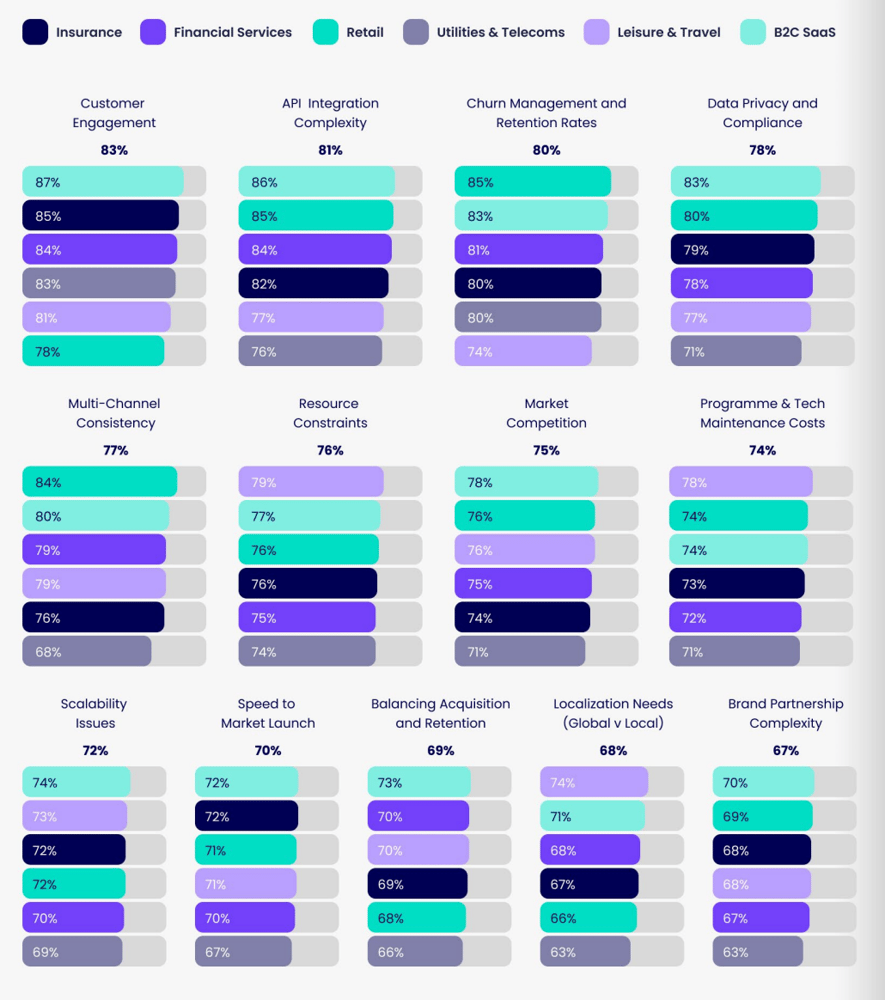
Customer engagement (85%) ranks as the biggest challenge, with (80%) of insurers citing churn issues. These challenges have intensified, as insurance interactions are infrequent, making each customer touchpoint critical.
Let’s explore some of these challenges in more detail.
Why Do Brief, Transactional Interactions Hurt Insurance Loyalty?Little day-to-day contact across digital channels leaves almost no room to build a relationship. Touchpoints are largely limited to renewal and claims, so brand presence fades between those moments. When customers have little to remember beyond price, a well-timed competitor offer can dislodge them with minimal effort.
Our recent research shows that 85% of insurance companies struggle with customer engagement, making it the sector's biggest loyalty challenge.
|
Why Are Trust and Retention Declining in Insurance?Trust and retention are declining in insurance because providers have so few opportunities to build rapport and demonstrate value outside renewal periods. Without those touchpoints, customers are left wondering whether they are getting their money's worth.
When trust is low, price becomes the primary decision factor. That is precisely the scenario most insurers want to avoid. To counter it, strengthen transparency in the claims experience, communicate proactively across digital channels, and deliver personalised rewards through data analytics. |
How Is Regulatory Change Disrupting Insurance Loyalty Strategies?In the UK, reforms are now disrupting insurance loyalty strategies by removing the pricing tactics insurers have traditionally relied on to acquire and retain customers. Regulations now prioritise fair value and transparent outcomes, which narrows the room for price-driven approaches and forces a rethink of acquisition, retention, and loyalty economics.
These changes protect consumers, but they also force a reset. Unsustainably low introductory deals are no longer viable, so insurers must compete on experience. The days of subsidising aggressive new customer acquisition with loyal customer premiums are over. |
What Do Digital-First Customers Expect From Their Insurer?People want quick, intuitive journeys across digital channels, consistent omnichannel experiences, and personalised experiences that prove value beyond the policy. When those needs go unmet, trust weakens and price sensitivity rises.
The opportunity is to upgrade everyday interactions, not just renewals or the claims process. Use data analytics and artificial intelligence for timely nudges, make digital self-service effortless, and map the customer journey to remove friction. Personalised rewards and clear communications rebuild customer engagement, reduce customer churn, and show transparency where it matters. |
Why Are Insurance Customer Acquisition Costs Rising?As bids rise and regulation tightens, the same budget buys fewer prospects. Price comparison dynamics and compliance overheads push cost per acquisition higher, squeezing margins and making customer acquisition less efficient.
Every customer who leaves takes your sunk acquisition cost with them and forces you to spend again to fill the gap. That makes retention one of the most effective levers insurers have. |
How Do Commoditisation and Price Sensitivity Weaken Insurance Loyalty?Price comparison sites line policies up side by side with price in bold, and uniform cover descriptions make everything look the same. When offerings feel interchangeable, customers stop engaging, trust stalls, and switching feels low risk. |
Why Do Complex Policies and Claims Processes Drive Customers Away?Complex policies create confusion and friction at the moments that matter most. When customers are unsure what they bought or how to use it, satisfaction drops. At renewal, that confusion makes price the only thing they feel confident comparing, which raises churn even among long-tenured policyholders.
This frustration weakens relationships and mutes advocacy. The fix is to simplify wording, provide digital self-service with real-time updates, and use customer journey mapping and feedback to remove bottlenecks. |
How Are Evolving Customer Expectations Reshaping Insurance Loyalty?Simple journeys, personalised interactions, and clear value across digital channels are no longer differentiators. They are the minimum. Mobile-first, instant service has shifted from delight to baseline. Younger policyholders in particular expect digital self-service, always-on support, and transparent pricing and terms. |
How Do Legacy Systems and Organisational Silos Undermine Loyalty?Legacy systems and organisational silos undermine loyalty by preventing customers from getting the real-time, unified experience they now expect. Older technology stacks cannot support personalised interactions, and fragmented teams with limited data sharing slow decisions across digital channels. |
Does Loyalty Really Matter in the Insurance Industry?
Yes, it does. Loyalty in insurance is the tendency of policyholders to stay, buy more, and advocate, which drives customer lifetime value and lowers customer churn. The payoff shows up in two places: bigger revenue per customer over time and a clear cost advantage versus constant acquisition.
How Does Loyalty Lift Customer Lifetime Value?
Loyal customers generate more revenue through tenure and cross-selling. A policyholder who stays with you for ten years might generate 3-4 times the revenue of a one-year customer, even with loyalty discounts factored in. Predictable, long-term revenue also funds better service, data analytics, and innovation that deepen customer engagement.
Examples of journeys that expand CLV:
-
A home insurance customer who later adds auto, life, and umbrella policies.
-
A business client who expands coverage as their company grows.
-
A health insurance member who upgrades to premium plans as their family expands.
What Is the Cost Advantage of Retention Over Acquisition?
Retention is the practice of keeping existing customers, and it is typically cheaper than acquiring new ones. Industry analyses show acquiring a new insurance customer costs 5-9 times more more than keeping an existing one. That gap reflects marketing, commissions, onboarding, and underwriting efforts that repeat with every new customer.
Acquisition vs. Retention Expenses:
| Acquisition Expenses | Retention Expenses |
|
Marketing campaigns |
Renewal communications |
|
Agent commissions |
Loyalty benefits |
|
Underwriting time |
Streamlined claim processing |
|
Onboarding support |
Self-service tools |
Familiar customers already know your processes and trust your brand, which reduces support needs and friction in the claims process. Clear communications, digital self-service, and well-designed loyalty programmes keep costs down while sustaining satisfaction, advocacy, and long-run customer lifetime value.
What Are the Benefits of Customer Loyalty for Insurance Companies?
Loyal customers adopt digital self-service, engage more, and churn less. As we've seen, the result is stronger customer lifetime value, steadier cash flow, and a brand that wins on trust and reliability rather than price alone. Let's take a look at these in closer detail.
How Does Customer Loyalty Improve Insurance Profitability?Profitability improves as loyal policyholders bundle products, renew reliably, and require fewer incentives. Familiar customers navigate digital channels efficiently and make fewer basic enquiries. Lower servicing effort, higher tenure, and better cross-selling combine to lift margins while reducing dependence on costly acquisition campaigns and premium discounts to hit growth targets.
Lower servicing costsLoyal customers use digital self-service more often and need less guidance. Familiarity with forms and terminology shortens interactions, reduces rework, and frees agents for complex cases. Over time, operational effort falls and satisfaction improves across renewals and the claims process.
Fewer speculative claims
Long-tenured customers tend to claim only for significant issues. Clear expectations and proactive risk prevention encourage prudent use of cover. The result is fewer low-value claims, healthier loss ratios, and a calmer claims experience when it matters most.
Streamlined processesHistory and context travel with the customer. Renewals require less paperwork, fewer checks, and cleaner handoffs between underwriting, service, and claims. Shorter cycle times and fewer escalations follow, improving Net Promoter Score while lowering everyday operational friction.
Predictable cash flowConsistent renewals and multi-policy relationships stabilise revenue. A dependable base lets you plan investments in data analytics, automation, and service with confidence. Fewer billing exceptions and lapses reduce administrative strain and support disciplined pricing decisions.
|
|
How Does Loyalty Build Brand Trust and Reputation in Insurance?Trust grows through consistent outcomes and fair treatment during the claims process. Loyal customers give you room to fix issues and provide candid feedback instead of silently leaving. Strong retention signals quality to partners and analysts, strengthens reputation across the insurance ecosystem, and makes customers less susceptible to slightly cheaper competitor offers. |
|
Why Are Loyal Customers Easier to Cross-Sell To?Cross-selling potential rises as relationships deepen. Your existing customers convert at 60-70% for additional products versus just 5-20% for new prospects. You already hold data to personalise recommendations to life events and needs, the buying process feels safer, and multi-policy customers stay longer and generate higher customer lifetime value. |
|
How Do Loyal Customers Become Brand Ambassadors?Advocacy turns satisfied policyholders into a growth channel. Personal recommendations carry more weight than advertising and often bring similar risk profiles. Referred customers arrive with built-in confidence and require less persuasion. Word of mouth reduces marketing spend while adding pre-qualified prospects, reinforcing a virtuous cycle of engagement and retention.
|
Back to contents
How Do You Build Customer Loyalty in Insurance?
Building customer loyalty in insurance means earning repeat choice and advocacy by delivering value at every touchpoint, from first quote through to renewal and beyond. Leaders pair transparent pricing with simple products, effortless digital self-service, and a claims process that proves trust.
The seven steps below turn these principles into practical moves that improve retention and lifetime value.
|
|
|
|
Transparent pricing builds trust from day one. Customers can see exactly what drives their premium and how it changes over time, making them feel informed rather than suspicious. That clarity lowers churn and differentiates you beyond discounts.
|
|
|
|
|
|
|
|
|
|
|
|
Trust is built through clear advice, honest conversations about what a policy does and does not cover, and a claims process that delivers on its promises. When customers experience that consistency across every channel, renewal becomes the easy choice.
|
|
|
|
|
|
|
|
|
|
|
|
|
|
|
|
|
|
How Should You Implement Direct Financial Rewards?Use clear, repeatable incentives that acknowledge good behaviour and tenure. Tie rewards to outcomes customers control, and make redemption simple through digital self-service. The goal is to lift engagement and customer lifetime value while supporting healthier loss ratios.
|
|
|
|
|
|
How Do You Track Metrics Beyond Simple Retention?Track policy persistency ratios, multi-policy households, customer lifetime value, and referral rates. These metrics reveal depth, breadth, and advocacy. Review them by product and channel to spot where digital self-service, claims process experience, or pricing changes lift engagement and reduce customer churn.
How Do You Use Net Promoter Score Effectively?Run regular Net Promoter Score surveys and trend them by segment, product, and journey stage. Pair scores with verbatim feedback to find specific fixes. Follow up with detractors quickly, and share “you said, we did” updates. When NPS moves with a change, you have a credible signal to scale.
What Should Segmented Churn Analysis Include?Analyse churn by tenure, policy mix, price sensitivity, and claims history. Quantify full cost: acquisition spend, lost future revenue, and referral drag. Identify patterns you can influence, like first-year lapses after claims decisions or renewal friction, then prioritise actions with the highest financial impact on CLV.
How Do You Map the Entire Customer Journey?Create a journey map that visualises every touchpoint from quote to claim to renewal. Mark pain points, handoffs, and moments that matter. Use customer feedback and operational data to validate. Fix the weakest link first, because one broken step can outweigh many smooth ones when customers decide to stay or go. |
|


Back to contents
What Are the Best Practices for a Customer-Centric Loyalty Strategy?
The best insurers build loyalty into daily operations. That means clear differentiation, smart use of data and technology, and frontline teams equipped to deliver visible value at every touchpoint.
Here are the practices that make the biggest difference.
Stand Out From the CompetitionThe insurers that stand out focus on the moments that shape how customers remember them. A fast, fair claims process, proactive guidance, and personalised touchpoints across digital channels build engagement, trust, and brand loyalty, making renewal feel easier than switching.
Create signature experiences competitors cannot copyA dedicated claims concierge or a personalised annual coverage review becomes a memorable moment that differentiates your brand. These touchpoints act as your calling card in the market and shift attention from price to service quality and reassurance when customers need it most.
Lean into authentic strengths rather than spreading thin
If you are known for speedy claims, make that the centrepiece. If you excel locally, build community connections that national carriers cannot match. Playing to real advantages feels credible, resonates with customers, and concentrates investment where it delivers distinctive value.
Solve specific pain points better than anyoneIf research shows customers hate paperwork, design the simplest documentation process in the industry. Targeted fixes create stories people retell and generate word of mouth that generic improvements rarely achieve. Clarity and ease at notorious friction points travel farther than broad promises. |
|
Implement Customer FeedbackOnce you have a clear market position, keep sharpening it with real customer insight. Treat feedback as an operating system: collect it continuously, act on it visibly, and let patterns guide decisions. This rhythm lifts customer satisfaction, reduces churn, and focuses effort on moments that matter in the claims process and renewals. Make feedback collection systematic rather than occasionalRun regular pulse surveys, post-interaction ratings, and annual relationship reviews across digital channels. Tag each response to a journey stage so you can spot friction in context. Pair qualitative comments with Net Promoter Score to see both the “why” and the trend, and feed insights straight into your improvement backlog.
The key is closing the feedback loop visiblyWhen customers suggest improvements, implement changes where possible and tell them what you did. A simple “you said, we did” update builds trust and reliability. Share wins in-app and by email, and route unresolved issues for fast follow-up. Visible action encourages ongoing participation in your feedback systems. Over time, use those feedback patterns to drive strategic decisionsPrioritise themes many customers mention over nice-to-have features. Quantify impact on churn and customer lifetime value, then fund the highest-leverage fixes first. Build customer advisory panels to test concepts before launch, reduce rework, and avoid costly missteps. Let measured outcomes decide what you scale next. |
|
Build a Complete Insurance EcosystemA complete insurance ecosystem connects services, partners, and digital self-service into a single experience that extends value beyond risk protection. Policy management, claims, and payments sit under one roof, adding everyday relevance that keeps customers engaged, reduces price sensitivity, and makes renewal the path of least resistance.
As these pieces connect, the experience starts to feel more seamless. Auto customers move from incident to preferred repair without repeating details. Life customers reach estate resources inside the same app. Clear journeys, timely updates, and simple choices turn a static policy into a living service, strengthening loyalty across the insurance ecosystem. |
|
Transform Your Agents Into Loyalty ChampionsTrain your agents to manage relationships, diagnose needs, provide personalised guidance, and maintain proactive communication across digital channels. Equip them with the right tools and align incentives to retention so everyday interactions lead you closer to your business objectives.
|
|
Use Technology to Enhance the Customer ExperienceTechnology should make insurance easy to use every day. Prioritise digital self-service that removes friction and keep experiences consistent across channels. The goal is a customer who never has to ask "why can't I just do this online?" Focus on four priorities:
|
|
Leverage Data to Power Your Loyalty StrategyYour customers are already telling you what they need through their behaviour, feedback, and engagement patterns. The challenge is turning that signal into timely action. Here is where to focus:
Identify distinct loyalty drivers by group. Young urban renters and suburban homeowners respond to different retention tactics, so tailor messaging, channels, and offers to each segment’s needs and preferences.
Pinpoint what matters most to each group and fund high-impact fixes. Focus budget on improvements that shift renewal intent rather than broad enhancements that do not move the needle.
Spot at-risk customers early using signals such as reduced engagement, claim outcomes, and price sensitivity. Trigger proactive outreach while relationships are still recoverable.
Use existing data to predict moments like marriage, home purchase, or retirement. Engage with relevant guidance and products before competitors appear, reinforcing trust and reliability. |
Back to contents
How Do You Measure the Impact of Loyalty in Insurance?
Set clear metrics on day one and review them consistently so improvements are visible and investment decisions are evidence-based. Our research shows that 72% of businesses face scalability issues with their loyalty initiatives, which makes getting this right from the start non-negotiable.
Which KPIs Should You Track for Insurance Loyalty?The right KPIs go beyond headline retention and reveal the depth, breadth, and momentum of your customer relationships. Focus on metrics that tell you whether people are staying, buying more, and telling others about you:
|
|
Why Does Net Promoter Score Matter for Insurance Loyalty?Net Promoter Score is a single-question measure of advocacy that predicts renewal and expansion. Promoters (scoring 9-10) typically stay with insurers 1.8 times longer than detractors and generate more revenue through additional products and referrals. |
|
How Should You Analyse Customer Churn and Retention in Insurance?Start by segmenting churn by value tiers, tenure, and policy mix to understand the real impact on profitability. Conduct structured exit interviews to uncover drivers beyond price, such as service disappointments or lack of recognition. |
How Does Customer Journey Mapping Strengthen Insurance Loyalty?
Customer journey mapping visualises the full lifecycle from awareness to renewal across every touchpoint. By plotting each stage and identifying moments of truth, including the claims process, insurers can spot friction before customers feel it, fix the experience where it matters most, and deepen engagement across the entire insurance ecosystem.


The main goals are to surface pain points that hinder satisfaction and to proactively exceed expectations. Implementing the earlier themes, such as aligning internal processes with customer needs, breaking silos, and investing in technology solutions, such as data analytics and digital self-service, will optimise journeys.
Treat mapping as ongoing too. Constantly reassess strategies, gather customer feedback, and adapt to changing expectations.
What Future Trends and Innovations Will Shape Insurance Loyalty?
Artificial intelligence is pushing loyalty into a new era of hyper-personalisation. Forward-thinking insurers are already using machine learning to predict needs and trigger timely, helpful moments, and adoption is accelerating.
Our 2025 Loyalty Uncovered Report shows 62% of businesses investing in AI and machine learning, with insurance companies at 63%, slightly above the average.
Behavioural economics is also reshaping programme design. Loss aversion makes status tiers worth keeping. The endowment effect highlights accumulated benefits that feel too valuable to walk away from. Present bias makes small immediate rewards the gateway to longer-term engagement. These principles align offers with how people actually decide, without relying on constant price cuts.
The advice here is simple: move at a pace that fits your segments and position, but move decisively. Pilot use cases, measure the impact on retention and customer lifetime value, then scale what works. Early movers earn an advantage in data, models, and customer feedback.
The window for easy differentiation is narrowing quickly. You need to choose soon whether you'll lead or follow.
What Are the Next Steps for Customer Loyalty in the Insurance Industry?
Building lasting loyalty means treating every touchpoint as part of a single, designed relationship. Shift from transactional interactions to genuine partnerships that blend clear pricing, simple products, and a dependable claims process.
Design journeys that balance emotion and utility. Pair human reassurance with practical wins: fast first contact on claims, proactive updates, and meaningful, personalised rewards. Use data to time guidance around life events, keep communications jargon-free, and make digital self-service effortless.
Ready to put these strategies into practice? Download our Insurance Retention Action Plan for checklists, templates, and KPIs covering segmentation, journey mapping, NPS cadence, and loyalty programme design.
FAQs
How can insurance companies increase customer loyalty?
Insurance companies can increase customer loyalty by focusing on fair pricing, providing excellent customer service, personalising experiences, offering value-added services, and leveraging technology to create seamless, convenient interactions across all touchpoints.
What role does customer experience play in building loyalty in the insurance industry?
Customer experience plays a vital role in building loyalty in the insurance industry. By delivering seamless, personalised, and hassle-free experiences across all channels, insurers can differentiate themselves and create meaningful connections with customers.
How can data analytics help insurance companies improve customer retention?
Data analytics can help insurance companies improve customer retention by providing valuable insights into customer behaviour, preferences, and needs. Insurers can tailor their products, services, and communications to better resonate with individual customers.
What are some effective strategies for reducing churn rates in the insurance industry?
Effective strategies for reducing churn rates in the insurance industry include proactively monitoring customer engagement, implementing targeted retention campaigns, simplifying complex processes, and offering personalised incentives to at-risk customers.
How can insurance companies leverage digital channels to enhance customer engagement?
Insurance companies can leverage digital channels to enhance customer engagement by developing user-friendly mobile apps, online portals, and chatbots that provide 24/7 access to information and support. Integrating a seamless omnichannel experience makes interacting with your company easier for customers.
What impact can personalisation have on customer loyalty in the insurance industry?
Personalisation can have a significant impact on customer loyalty in the insurance industry. Personalised experiences, such as customised policy recommendations and targeted rewards foster a stronger sense of connection and loyalty.
What role do loyalty programmes play in the insurance industry?
Loyalty programmes play a crucial role in the insurance industry by incentivising repeat business, encouraging customer engagement, and strengthening relationships. Relevant, personalised rewards based on customer preferences and behaviour improve value perception that also drives long term advocacy.
What are the benefits of building strong customer loyalty in the insurance industry?
Strong customer loyalty offers numerous benefits, including increased customer retention, higher lifetime value, reduced acquisition costs, and positive word-of-mouth referrals. Loyal customers are more likely to purchase additional products, provide valuable feedback, and endorse the brand.
Author Bio, Written By:
Mark Camp | CEO & Founder at PropelloCloud.com | LinkedIn
Mark is the Founder and CEO of Propello Cloud, an innovative SaaS platform for loyalty and customer engagement. With over 20 years of marketing experience, he is passionate about helping brands boost retention and acquisition with scalable loyalty solutions.
Mark is an expert in loyalty and engagement strategy, having worked with major enterprise clients across industries to drive growth through rewards programmes. He leads Propello Cloud's mission to deliver versatile platforms that help organisations attract, engage and retain customers.

.png)